

Table of Contents
Introduction
Civil Engineering is one of the oldest and most respected branches of engineering. It is responsible for designing, building, and maintaining the infrastructure that supports modern society. From the roads we travel on every day to the buildings we live and work in, civil engineering plays an important role in almost every aspect of our lives. The field combines scientific knowledge, technical skills, and practical problem-solving to create structures that are safe, durable, and functional. As cities continue to grow and technology advances, the demand for innovative civil engineer’s solutions continues to increase.
What is Civil Engineering?
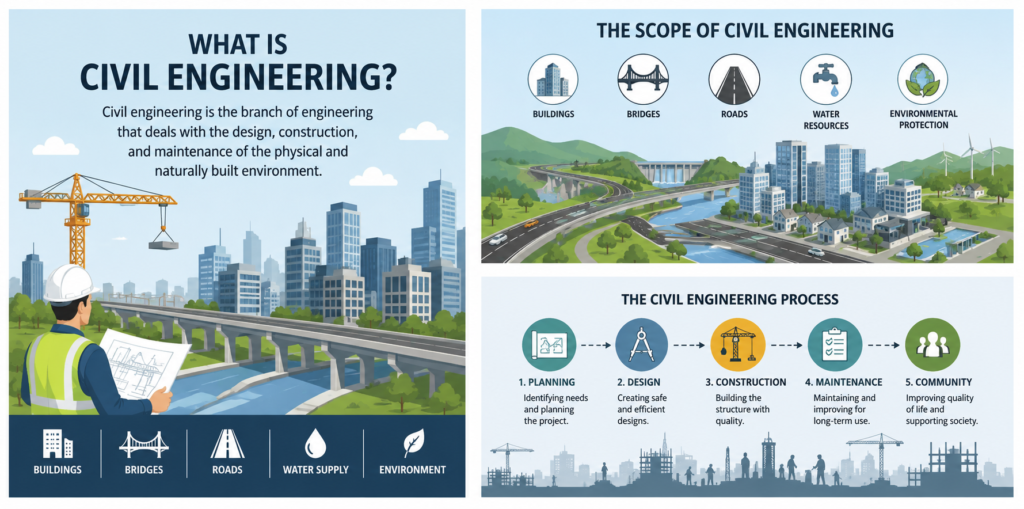
Civil Engineering is a branch of engineering that focuses on the planning, design, construction, and maintenance of physical infrastructure. Civil engineers work on projects such as buildings, bridges, highways, dams, airports, water supply systems, and many other essential facilities. Their main goal is to create structures that meet public needs while ensuring safety, efficiency, and sustainability.
The profession requires knowledge of mathematics, physics, building materials, and construction methods. Civil engineers often work closely with architects, contractors, surveyors, and government authorities to successfully complete projects.
Types
Civil Engineering is a broad field that consists of several specialized branches:
Structural Engineering: focuses on designing buildings, bridges, towers, and other structures capable of withstanding various loads and environmental conditions.
Geotechnical Engineering: deals with soil, rock, and foundation systems. It helps engineers understand ground conditions before construction begins.
Transportation Engineering: is concerned with roads, highways, railways, airports, and traffic systems that help people and goods move safely and efficiently.
Water Resources Engineering: focuses on water supply, drainage systems, flood control, irrigation networks, and hydraulic structures.
Environmental Engineering: works on improving environmental quality through wastewater treatment, pollution control, and sustainable waste management practices.
Construction Engineering and Management: involves planning, coordinating, and managing construction activities to ensure projects are completed on time and within budget.
Surveying and Geomatics Engineering: uses advanced technologies to measure land, determine boundaries, and collect accurate spatial data for construction projects.
Coastal and Ocean Engineering: focuses on the design and protection of coastal infrastructure such as ports, harbors, seawalls, and offshore facilities.
Advantages
One of the biggest advantages of civil engineering is its direct impact on society. Civil engineers help create the infrastructure that supports economic growth and improves people’s quality of life.
The field offers a wide range of career opportunities in both the public and private sectors. Engineers can work in design, construction, project management, research, consulting, or government organizations.
Civil engineering also provides opportunities to work on large-scale projects that leave a lasting impact on communities. Seeing a project progress from an idea to a completed structure can be highly rewarding.
Another advantage is the continuous learning involved in the profession. New technologies, materials, and construction methods are constantly being developed, making the field dynamic and interesting.
Disadvantages
Despite its many benefits, civil engineering also comes with certain challenges.
Many projects require significant financial investment and careful planning. Delays caused by weather conditions, material shortages, or regulatory approvals can affect project schedules.
Civil engineers often carry a high level of responsibility because public safety depends on the quality and reliability of their work. Even small mistakes can lead to serious consequences.
Construction activities may also have environmental impacts if not managed properly. Engineers must balance development needs with environmental protection and sustainability goals.
In some cases, engineers may need to work under tight deadlines or visit construction sites in difficult weather conditions, which can be demanding at times.
Applications of Civil Engineering
Civil Engineering has applications in almost every area of infrastructure development. It is used in the construction of residential buildings, commercial complexes, hospitals, schools, and industrial facilities.
The field is also essential for transportation projects such as highways, bridges, tunnels, railways, airports, and metro systems. These projects improve connectivity and support economic activities.
Water-related projects including dams, reservoirs, irrigation systems, drainage networks, and water treatment plants are also designed and managed by civil engineers.
Additionally, civil engineering plays an important role in environmental protection through wastewater treatment facilities, waste management systems, and sustainable infrastructure development.
Frequently Asked Questions
What does a civil engineer do?
A civil engineer plans, designs, constructs, and maintains infrastructure projects while ensuring safety, quality, and efficiency.
Is Civil Engineering a good career choice?
Yes, civil engineering offers stable career opportunities, competitive salaries, and the chance to contribute to meaningful projects that benefit society.
What skills are important for civil engineers?
Strong analytical thinking, problem-solving abilities, technical knowledge, communication skills, and project management capabilities are important for success in this field.
Which software is commonly used in Civil Engineering?
Popular software includes AutoCAD, Civil 3D, STAAD.Pro, ETABS, SAP2000, Revit, and Primavera P6.
What is the future of Civil Engineering?
The future of civil engineering is closely linked with sustainable construction, smart cities, green infrastructure, and advanced digital technologies that improve efficiency and project performance.
Conclusion
Civil Engineering is a vital profession that helps shape the modern world. It combines creativity, technical expertise, and practical knowledge to develop infrastructure that supports communities and economies. Whether it is a bridge connecting cities, a water system supplying clean water, or a building providing safe shelter, civil engineering contributes to everyday life in countless ways. As global infrastructure needs continue to grow, civil engineers will remain at the forefront of creating safer, smarter, and more sustainable solutions for future generations.